Historic St. Anthony Catholic Church
258 Ohio, Wichita, Ks
2nd St. & Ohio
Two blocks east of Old Town
Sunday Mass at 1:oo
English/Latin missals provided. Join us for coffee and donuts after mass downstairs in the St. Clair/Sunshine room, south exterior basement entrance.
Pastor of St. Anthony Parish: Fr. Ben Nguyen
EFLR Celebrants: Fr. John Jirak, Fr Nicholas Voelker
Master of Ceremonies: Tony Strunk
Choir Director: Bernie Dette


Continuing News

+To submit an article or if you have comments contact me, Mark, at bumpy187@gmail.com.

Like us on Facebook:https://www.facebook.com/VeniteMissaEst?ref=hl

Did You Know

Mass Propers, the readings that change everyday, can be found in the red missalettes at the entrance of church?

Fr. Nicholas Voelker celebrates Low Mass Saturdays at 8:00 a.m., St. Mary's Catholic Church, 106 East 8th street, Newton. There is no mass this Saturday, January 30, 2016.


Friday, September 5, 2008

Post #47

Topics: Guest Blogger, Jim Spencer: Leonine Prayers After Low Mass....Guest Blogger, Michael J. O’Neill: Passover Meal Transformed into the Eucharistic Sacrifice...
Douay-Rheims Hardbound Bible : A Great Buy for $39 Bucks...USCCB:Constant Church Teaching, Respect For Human Life...St. Anthony Stained Glass Windows:Description and Explanation.

@@@@@@@@@@@@@@@@@@@@@@@@@@@@@

Leonine Prayers After Low Mass
By Guest Blogger Jim Spencer

Editors note: Mr. Jim Spencer was the original writer for Venite Missa Est! In fact the name of this blog was his idea since Jim speaks fluent Latin. Since Jim is an actual writer his wealth of knowledge is endless and his love of The Lord, Blessed Mother and Holy Catholic Church is boundless. This post was originally an email and Jim has been gracious to let us post it here.

In case you are curious about the slight variation Fr. Lies has introduced into the Leonine Prayers said after low Masses, here's what the 1962 edition of The Celebration of Mass by Fr. J. B. O'Connell has to say on the subject (Chapter 16, page 299):

". . . These are to be said . . . by the celebrant and the congregation, either alternatively, as is the practice in some places, or all together. They may be recited in Latin or in the vernacular . . . ."

In other words, Fr. Lies exercises a legitimate option when he sings the third Ave in Latin and follows it by the Salve Regina in Latin. And the congregation may join him in both. Frankly, I rather like this variation he has introduced, and I'll like it a whole bunch more when I finally learn the music for the Ave some better. I wish he would say or sing the prayer immediately after the Salve Regina in Latin rather than English (Pray for us, Holy Mother of God), which in Latin is: "Ora pro nobis Sancta Dei Genetrix." We would answer "Ut digni efficiamur promissionibus Christi." Our rosary group does this every Monday evening. But all of this is entirely his option.

Incidentally, if you've forgotten (as I had) the history of the Leonine Prayers, here's a brief version thereof taken from the same O'Connell book but on page 121:

"In 1884 & 1886 Leo XIII ordered special prayers -- the Ave thrice, the Salve Regina, and two other prayers -- to be recited after a private Mass in all churches for the needs of the Church. This prescription was renewed by St. Pius X (1903) and by Benedict XV (1915). Pius XI, in a Consistoral Allocution of June 30, 1930, ordered these prayers to be said for Russia . . . ."

"To these Leonine Prayers, St. Pius X, in 1904, allowed the addition of the ejaculation "Most Sacred Heart of Jesus, have mercy on us,' said three times . . . ."


@@@@@@@@@@@@@@@@@@@@@@@@@@@@@

Here is Just a Great Picture I Found on the Web
Click on the epicture for a bigger view.

@@@@@@@@@@@@@@@@@@@@@@@@@@@@@


Passover Meal Transformed into the Eucharistic Sacrifice of the New Covenant By Guest Blogger Michael J. O’Neill’
References include How Christ Said the First Mass by Fr. James L. Meagher, The Roman Catechism, and the Douay Rheims Bible.

On Holy Thursday Our Lord Jesus transformed the Passover Meal into the Eucharistic Sacrifice of the New Covenant.

Once Our Lord Jesus and His twelve apostles assembled in the Upper Room, located over the burial-site of the mysterious priest-king Melchesedech, King David, and his son Solomon, He employed the “sacramentals of the Old Law, bread, wine, oil, incense, to institute the Eucharistic Sacrifice” of the New Law (Fr. Meagher, pg. 86).

From Saint Paul’s epistle to the Hebrews, we learn that Melchesdech is “without father, without mother, without genealogy, having neither beginning of days, nor end of life, but likened unto the Son of God, who continues a priest forever” (Hebrews 7; 3).

That Our Savior used the familiar rituals, gestures, and implements did not escape the notice of the apostles who recognized the profound significance of what they were witnessing. Moreover, several of the ancient liturgies of the Catholic Church are attributed to the Apostles Peter, Mark, and James. With the unleavened bread, called Matzoth in His sacred hands, Jesus began the liturgy “by blessing the bread and wine at table;” similarly, a Catholic priest of the Latin-rite with “the Sacred host in his hands breaks the smaller Hosts when distributing Communion” (Fr. Meagher, pg. 90).

That Christ instituted the Sacrifice and Sacrament of the Holy Eucharist at the Last Supper was foretold by the prophets of the Old Testament and the sacrificial Temple liturgies which also prepared for the eternal priesthood of the Catholic Church. Because of the infidelity of the Jews and their rejection of Jesus Christ, “I have no pleasure in you, saith the Lord of hosts, and I will not receive a gift from your hand [i.e. Hebrew priests]… from the rising of the sun even to the going down, my name is great among the Gentiles, and every place there is sacrifice, a clean oblation” (Malachias 1: 10-11). The ‘clean oblation’ prophesied by Malachias is the unbloody, Eucharistic Sacrifice of the New Law.

In the next installment this author will review the Holy Church’s doctrinal teachings on the Holy Sacrifice from the Council of Trent, papal encyclicals, and Monsignor Klaus Gamber’s comprehensive book, The Reform of the Roman Liturgy: Its Problems and Background.


@@@@@@@@@@@@@@@@@@@@@@@@@@@@@


Douay-Rheims Hardbound Bible from Loreto Publications


One of my classes this fall is Reading the Old Testament and has proven to be quite interesting. It is a look at the Old Testament, not in religious terms, but from a socio-political, historical and ethnic viewpoint. While a bible is not necessary for the class, I realized that I do not have a bible (though everyone I know does) so I asked Mr. Jim Spencer (see previous article) what bible he read and/or recommended. He recommended the Douay-Rheims Bible available at Tan Books but even cheaper at Loreto publications...$39.00!! Here is the description from the Loreto Publications web site at http://loretopubs.org/index.php?target=products&product_id=56 I can't wait till it arrives!

Even after all of the modern "revisions" of the bible that are now available to Catholics, many still think that the Douay-Rheims version, (the only Catholic English bible in use for almost 400 years) is the very best ever produced. We at Loreto agree, and will now be offering, this beautiful genuine bonded leather hardbound gift edition for only $39.95! Same as our previous imitation leather addition! This Bible is going to be a big seller – it fills the great need for a small (5 1/2" x 8 1/2") good quality hardbound Douay-Rheims bible. It is a perfect gift for Christmas, First Communions, Confirmations, weddings, birthdays, etc. and is also great for those who want a portable bible which is legible, durable, and handsome.

* Douay-Challoner version
* Hardbound Smythe-sewn binding
* Genuine bonded leather cover
* Gold embossed title and decoration on spine and cover
* Top quality bible paper
* Family Register pages
* Papal Encyclical at front
* Sharp, clear, and readable text
* Gold and red satin ribbon page markers
* Individually shrink wrapped
* 32 illustrations
* Maps
* Index


@@@@@@@@@@@@@@@@@@@@@@@@@@@@@

USCCB:Constant Church Teaching, Respect For Human Life
Submitted by Larry Bethel

Fact sheet by the USCCB Committee on Pro-Life Activities.

The Catechism of the Catholic Church states: “Since the first century the Church has affirmed the moral evil of every procured abortion. This teaching has not changed and remains unchangeable. Direct abortion, that is to say, abortion willed either as an end or a means, is gravely contrary to the moral law” (No. 2271).

In response to those who say this teaching has changed or is of recent origin, here are the facts:

  • From earliest times, Christians sharply distinguished themselves from surrounding pagan cultures by rejecting abortion and infanticide. The earliest widely used documents of Christian teaching and practice after the New Testament in the 1st and 2nd centuries, the Didache (Teaching of the Twelve Apostles) and Letter of Barnabas, condemned both practices, as did early regional and particular Church councils.
  • To be sure, knowledge of human embryology was very limited until recent times. Many Christian thinkers accepted the biological theories of their time, based on the writings of Aristotle (4th century BC) and other philosophers. Aristotle assumed a process was needed over time to turn the matter from a woman’s womb into a being that could receive a specifically human form or soul. The active formative power for this process was thought to come entirely from the man – the existence of the human ovum (egg), like so much of basic biology, was unknown.
  • However, such mistaken biological theories never changed the Church’s common conviction that abortion is gravely wrong at every stage. At the very least, early abortion was seen as attacking a being with a human destiny, being prepared by God to receive an immortal soul (cf. Jeremiah 1:5: “Before I formed you in the womb, I knew you”).
  • In the 5th century AD this rejection of abortion at every stage was affirmed by the great bishop-theologian St. Augustine. He knew of theories about the human soul not being present until some weeks into pregnancy. Because he used the Greek Septuagint translation of the Old Testament, he also thought the ancient Israelites had imposed a more severe penalty for accidentally causing a miscarriage if the fetus was “fully formed” (Exodus 21: 22-23), language not found in any known Hebrew version of this passage. But he also held that human knowledge of biology was very limited, and he wisely warned against misusing such theories to risk committing homicide. He added that God has the power to make up all human deficiencies or lack of development in the Resurrection, so we cannot assume that the earliest aborted children will be excluded from enjoying eternal life with God.
  • In the 13th century, St. Thomas Aquinas made extensive use of Aristotle’s thought, including his theory that the rational human soul is not present in the first few weeks of pregnancy. But he also rejected abortion as gravely wrong at every stage, observing that it is a sin “against nature” to reject God’s gift of a new life.
  • During these centuries, theories derived from Aristotle and others influenced the grading of penalties for abortion in Church law. Some canonical penalties were more severe for a direct abortion after the stage when the human soul was thought to be present. However, abortion at all stages continued to be seen as a grave moral evil.

  • From the 13th to 19th centuries, some theologians speculated about rare and difficult cases where they thought an abortion before “formation” or “ensoulment” might be morally justified. But these theories were discussed and then always rejected, as the Church refined and reaffirmed its understanding of abortion as an intrinsically evil act that can never be morally right.
  • In 1827, with the discovery of the human ovum, the mistaken biology of Aristotle was discredited. Scientists increasingly understood that the union of sperm and egg at conception produces a new living being that is distinct from both mother and father. Modern genetics demonstrated that this individual is, at the outset, distinctively human, with the inherent and active potential to mature into a human fetus, infant, child and adult. From 1869 onward the obsolete distinction between the “ensouled” and “unensouled” fetus was permanently removed from canon law on abortion.
  • Secular laws against abortion were being reformed at the same time and in the same way, based on secular medical experts’ realization that “no other doctrine appears to be consonant with reason or physiology but that which admits the embryo to possess vitality from the very moment of conception” (American Medical Association, Report on Criminal Abortion, 1871).
  • Thus modern science has not changed the Church’s constant teaching against abortion, but has underscored how important and reasonable it is, by confirming that the life of each individual of the human species begins with the earliest embryo.
  • Given the scientific fact that a human life begins at conception, the only moral norm needed to understand the Church’s opposition to abortion is the principle that each and every human life has inherent dignity, and thus must be treated with the respect due to a human person. This is the foundation for the Church’s social doctrine, including its teachings on war, the use of capital punishment, euthanasia, health care, poverty and immigration. Conversely, to claim that some live human beings do not deserve respect or should not be treated as “persons” (based on changeable factors such as age, condition, location, or lack of mental or physical abilities) is to deny the very idea of inherent human rights. Such a claim undermines respect for the lives of many vulnerable people before and after birth.

For more information: Congregation for the Doctrine of the Faith, Declaration on Procured Abortion (1974), nos. 6-7; John R. Connery, S.J., Abortion: The Development of the Roman Catholic Perspective (1977); Germain Grisez, Abortion: The Myths, the Realities, and the Arguments (1970), Chapter IV; U.S. Conference of Catholic Bishops, On Embryonic Stem Cell Research (2008); Pope John Paul II, Evangelium Vitae (1995), nos. 61-2.


@@@@@@@@@@@@@@@@@@@@@@@@@@@@@

St. Anthony Stained Glass Windows
Provided by Bob Walterscheid

Mr. Bob Walterscheid has provided these descriptions of the windows in St. Anthony (also see Post #39).

Good Shepherd Window
The fleur-de-lis at the top of the window is a symbol of the human nature of Christ and that he walked this earth as our Good Shepherd. Also near the top of the window is the Triumphal Lamb holding a banner. This lamb is referred to as the Agnus Dei (meaning Lamb of God) and is a sign of victory and resurrection.
The lamb is seated on the Book of Seven Seals referenced in Revelation Chapters 5 and 6. Christ is ushering all His sheep, including the lost one, through a door, a reference to His statement “I am the Door” John 10:9. Above the door lintel are wheat and grapes, symbols of the Eucharistic bread and wine. On the rocks behind the figure of Christ are red and gold garments, raiment fit for a king.
The inscription reads, “To the memory of H. H. Debbrect”, one of the original founders of the parish. He was one of the two builders of the original St. Boniface Church, the original church of the parish property.
The Poor Souls Window

The intertwined letters IHS is a monogram of Christ and are the first three letters in the Greek word for Jesus. Above the letters are the fish and loaf symbol, representing the feeding of the five thousand as told in the Gospels.
Mary is depicted as giving the scapular to mankind and offering assistance to the poor souls in purgatory as she holds her child Jesus, their Savior.
This is the only window with an English inscription: “In memory of John Braitsch.” This gentleman belonged to the parish from its earliest days and owned a prosperous shoe store on East Douglas.
St. Joseph’s Window

This window depicts the death of Joseph, earthly father of Jesus. Joseph played a vital role in Jesus’ life. Matthew 1:19 refers to Joseph as “a just man”.
At the very top of the window is a fleur-de-lis symbolizing the human nature of Christ. Immediately below the fleur-de-lis is a lily intertwined with a carpenter’s square. Joseph was a carpenter and passed down his occupation to Jesus. There are more carpentry tools on the wall above Joseph’s head.
Lilies abound in this window; tradition has it that the fragrance of lilies filled the room as Joseph lay dying. Lilies are a symbol of Joseph’s purity. It is said that Christ was present at Joseph’s death and we see him by the bed, along with Mary and two angels. The lamp above the figures has three lights symbolizing the Trinity.
The German inscription translates, “Donated by St. Joseph’s Friendly Society”. That society was the original men’s organization in the parish.

St. Dominic Window

The fleur-de-lis at the top of the window is a variant of the lily, a symbol of purity and the Virgin Mary. Below is a heart pierced with a dagger, representing St. Simeon’s prophecy to Mary at Christ’s circumcision that ‘a sword will pierce your heart’. Mary is shown on a throne with her child
Jesus presenting the rosary to the Dominicans, for it was St. Dominic who instituted the devotion of the rosary. St. Dominic is kneeling on the left and a nun wearing a crown of thorns is kneeling on the right. The Dominicans are dressed in brown Franciscan traveling cloaks rather that in their own black Dominican cloaks.
The German inscription reads, “Given by the Altar Society,” an original parish organization comprised of the married women of the parish.

Mary, Queen of Heaven Window

At the top of this window is the fleur-de-lis. In religious art, this is a symbol for the human nature of Christ.
The banner with the Latin words "Salve Regina" is translated as "Hail Queen". Mary, with angels surrounding her, is being taken up to heaven body and soul as the Apostles watch in awe. It is the teaching of the Catholic Church that at the death of the Blessed Virgin Mary her body was preserved from corruption and that shortly afterwards it was assumed (Latin., assumere, to take to) into Heaven and reunited to her soul. Pope Pius the XII, in 1950, solemnly defined the Assumption as a dogma. It has been a subject of belief for over 1,500 years, being stated by Saint Juvenal of Chalcedon in 451.
The German inscription reads, "To the memory of John Walterscheid". His sons immigrated to Wichita and were among the founding families of the parish.

St Rose of Lima Window

Isabel de Santa Maria de Flores was born in Lima, Peru of Spanish parents and took the name Rose at her confirmation. Noted for her beauty, she rejected all suitors and refused to marry. She became a Dominican tertiary and lived as a recluse in a shack in the garden she worked to help her parents. She is depicted in this window wearing a Carmelite habit which was the customary garb of the day. She holds a red rose symbolizing her purity and her name. On her head is a crown of thorns. She was deeply devoted to the Sacred Heart of Jesus featured at the top of the window.
The heart is encircled with a crown of thorns and has a cross and flames emerging from it. This flaming heart represents religious fervor and devotion to Jesus Christ. She is the patron saint of all South America. Above the Sacred Heart is the fish and loaves of bread. The German inscription reads, "Given by the Young Ladies Sodality".
In the first decades of the parish, the women of the parish had two organizations; the Young Ladies Sodality was for the unmarried young women. A sodality was a charitable church organization.

St Boniface Window

Originally the parish was named St. Boniface, reflecting its German heritage. St. Boniface was the first missionary sent by the pope in the eighth century to the German tribes. Unsuccessful at first with his conversion efforts, he learned of the Oak of Thor, a giant oak sacred to the pagans on Mount Gudenburg. Boniface began chopping the tree down as the pagans waited for him to be struck dead by their gods for his sacrilege. When the tree fell and nothing happened to him, the pagans were converted to Christianity. Not only did Boniface chop down the tree, he used lumber from it to build the first Christian chapel in Germany.
The ax and tree stump as well as the broken pillar symbolize this event. He was later made a bishop as reflected by his clothing. St. Boniface is holding a book with a dagger in it representing the manner of his death.
Pagans stabbed him to death with a dagger as he was reading the book of Gospels. The German inscription reads, "Given by the family of A. Gittrich",one of the original founders of the parish.

There are watercolor paintings of these windows by Jennifer Walterscheid available for sale in two sizes. They are excellent depictions of the windows and can be viewed just inside the doors at St. Anthony. Please contact Bob Walterscheid for more information.


Sunday, August 24, 2008

Post #46

Topics: Random Thoughts: Not Enough Time!...St. Anthony Catholic Church: Architecture.... From John Senior's: "The Restoration of Christian Culture"... Air-purifying Church Windows : Early Nano Technolog.... Confessions of a Traditional Catholic: Web Opinion Article.... Tradition Rising in Wisconsin: The Remnant Web Article

@@@@@@@@@@@@@@@@@@@@@@@@@@@@@

Random Thoughts
Not Enough Time!!!!
For those that don't know me I am a full time student (after many, many years) and work 33 hours per week plus some side jobs on the weekend. I have an unhealthy blogging addiction, two dogs, a sweetheart and chickens (and last week...our first eggs!) plus homework atop it all. Since this was the first week back at school, let me apologize for all the web articles I am posting, I realize you could read these all on your own...I just haven't had time to write original pieces.

@@@@@@@@@@@@@@@@@@@@@@@@@@@@@

St. Anthony Catholic Church
The Architecture

St. Anthony’s attains architectural significance through its being a well executed and preserved ecclesiastical product from the turn of the Century that speaks highly of Roman Catholic aspirations and ideals in Wichita at the time.

Stylistically, St. Anthony’s is a late Victorian Era design that makes sound use of the round, or Roman arch.
Such feature is of substantial historical importance, for it carries on the significant German Heritage of this Parish: this house of worship’s architectural spirit is that of the German Romanesque - a fusion of essential Gothicism with Romanesque forms that were somewhat peculiar to Northern Europe.

Construction of the exterior brick walls is expertly carried out and serves as a model for the brick mason’s art. Also notable is the eclectic wooden steeple/tower centered on the front with its Moorish design implications: perhaps this feature is meant to represent the faith’s universality.

It is realistically assumed that the Franciscan Order, when hiring Louis Piket, the Church architect, chose a designer who; had familiarity with the history of European Church architecture - especially with the Romanesque mode as interpreted in Germany. thus, continuity of regional and ethnical/national heritage was felt appropriate for the Parish of St. Anthony Church by is designer.


@@@@@@@@@@@@@@@@@@@@@@@@@@@@@

From John Senior's "The Restoration of Christian Culture"

Whatever we do in the political and social order, the indispensable foundation is prayer, the heart of which is the Holy Sacrifice of the Mass, the perfect prayer of Christ himself, Priest and Victim, revealing in an unbloody manner the bloody selfsame Sacrifice of Calvary.

What is Christian Culture? It is essentially the Mass.That is not my or anyone's opinion or theory or wish but the central fact of two thousand years of history. Christendom, what secularists call Western Civilization, is the Mass and the paraphenalia which protect and facilitate it. All architecture, art, political and social forms, economics, the way people live and feel and think, music, literature- all these things, when they are right, are ways of fostering and protecting the Holy Sacrifice of the Mass.

To enact a sacrifice, there must be an altar, an altar has to have a roof over it in case it rains; to reserve the Blessed Sacrament, we build a little House of Gold and over it a Tower of Ivory with a bell and a garden round about with roses and lilies of purity, emblems of the Virgin Mary- Rosa Mystica, Turris Davidica, Turris Eburnea, Domus Aurea- who carried his Body and His blood in her womb, Body of her body, Blood of her blood. And around the Church and garden, where we bury the faithful dead, the caretakers live, the priests and religous whose work is prayer, who keep the Mystery of Faith in its tabernacle of music and words in the Office of the Church; and around them the faithful who gather to worship and divide the other work that must be done in order to make the perpetuation of the Sacrifice possible - to raise the food and make the clothes and build and keep the peace so that generations to come may live for Him, so that the Sacrifice goes on even until the consummation of the world.

From John Senior's "The Restoration of Christian Culture"

@@@@@@@@@@@@@@@@@@@@@@@@@@@@@

Air-Purifying Church Windows
Early Nano Technology
from Nanite News @ nanitenews.com

Stained glass windows that are painted with gold purify the air when they are lit up by sunlight, a team of Queensland University of Technology experts have discovered.

Associate Professor Zhu Huai Yong, from QUT's School of Physical and Chemical Sciences said that glaziers in medieval forges were the first nanotechnologists who produced colors with gold nanoparticles of different sizes.

Professor Zhu said numerous church windows across Europe were decorated with glass colored in gold nanoparticles.

"For centuries people appreciated only the beautiful works of art, and long life of the colors, but little did they realise that these works of art are also, in modern language, photocatalytic air purifier with nanostructured gold catalyst," Professor Zhu said.

He said tiny particles of gold, energised by the sun, were able to destroy air-borne pollutants like volatile organic chemical (VOCs), which may often come from new furniture, carpets and paint in good condition.

"These VOCs create that 'new' smell as they are slowly released from walls and furniture, but they, along with methanol and carbon monoxide, are not good for your health, even in small amounts," he said.

"Gold, when in very small particles, becomes very active under sunlight.
"The electromagnetic field of the sunlight can couple with the oscillations of the electrons in the gold particles and creates a resonance.

"The magnetic field on the surface of the gold nanoparticles can be enhanced by up to hundred times, which breaks apart the pollutant molecules in the air."
Professor Zhu said the by-product was carbon dioxide, which was comparatively safe, particularly in the small amounts that would be created through this process.
He said the use of gold nanoparticles to drive chemical reactions opened up exciting possibilities for scientific research.

"This technology is solar-powered, and is very energy efficient, because only the particles of gold heat up," he said.

"In conventional chemical reactions, you heat up everything, which is a waste of energy.
"Once this technology can be applied to produce specialty chemicals at ambient temperature, it heralds significant changes in the economy and environmental impact of the chemical production." Note: This story has been adapted from a news release issued by the Queensland University of Technology


@@@@@@@@@@@@@@@@@@@@@@@@@@@@@

Confessions of a Traditional Catholic
by Steve Skojec for http://insidecatholic.com

"Hello. My name is Steve, and I'm a 'traditional' Catholic." So begins my admission of membership in a disparate group that, as you've already read, is far too well known for its bitterness, anger, and lack of evangelical spirit.

I don't like being typecast in this way. Just because I have a profound love and respect for -- and even a belief in the superiority of -- older liturgical and sacramental forms does not mean that I am an unreasonable malcontent oozing acid from every pore.

I am first and foremost a Catholic, and I detest even needing to wear a label to distinguish myself. Unfortunately, I must, for it is still an uncommon thing among Catholics to venerate many of the traditions that I hold dear. I'll be honest: There was a time when I was an "angry trad," when I lashed out at others as I clawed for a spiritual inheritance I felt was stolen from me. While this is probably a natural reaction, I now know it gained me nothing. There is no value in promoting the beauty of something when one's conduct in so doing is itself repulsive.

So why, then, are traditional Catholics so angry?

In his homily on October 21, 2007, the first time his parish would celebrate Mass in the Extraordinary Form following the promulgation of Summorum Pontificum, Rev. Franklyn McAfee, pastor of St. John the Beloved in McClean, Virginia, offered an insight: What flowed from the promised renewal of the Mass in the late 60s was something entirely new. The American Theologian Avery Cardinal Dulles has pointed out that the new rite of the Mass violated every norm for liturgical renewal prescribed by Vatican II. He said it was the only Mass in history that was put together by a committee. As a result . . . many people stopped going to Mass. Some even left the Church.

My parents were shaken but they did not abandon the Church. But my older sister did. In the 50s, more than 80 percent of parishioners attended Mass in their parish church. Today it is far less than 30 percent. It is not my purpose here to prove causality, but the fact that the change in the liturgy of the Roman Rite and the exodus of Catholics from the Church coincide is hard to dispute. People were hurt, immensely, by the drastic nature of the change. The liturgy on which they had been nourished their entire lives became something unrecognizable -- a Mass as alien to them as my first experiences with the old form were to me.

Some, like Sts. Padre Pio and JosemaríaEscrivá, asked and obtained permission from Rome to continue saying the older form of the Mass. And a group of intellectuals, artists, writers, and actors from England petitioned Rome not to change the Mass at all. Throughout the Catholic world, there was controversy and upheaval over the changing shape of the liturgy. Alfredo Cardinal Ottaviani asked during the first session of the Second Vatican Council if the gathered fathers wanted to "stir up wonder, or perhaps scandal among the Christian people, by introducing changes in so venerable a rite, that has been approved by so many centuries and is now so familiar?"

Following the Council, in his famous Intervention, the good cardinal, along with "a group of theologians, liturgists and pastors of souls," urged Pope Paul VI not to replace the venerable Mass of the Church with the new creation that was the Novus Ordo Missae. Their study showed quite clearly in spite of its brevity that if we consider the innovations implied or taken for granted which may of course be evaluated in different ways, the Novus Ordo represents, both as a whole and in its details, a striking departure from the Catholic theology of the Mass as it was formulated in Session XXII of the Council of Trent (emphasis added). Despite all of the objections, exceptions, and petitions, Rome moved ahead with the new rite.

The old liturgy was effectively suppressed, leaving innumerable Catholics shanghaied in a new Mass that adopted a different form, different postures, a different language, and a different theological focus than that to which they had been accustomed their entire lives. They felt alienated and forgotten.

When Pope John Paul II issued the apostolic letter Ecclesia Dei in 1988, in which he discussed the schismatic action of Archbishop Marcel Lefebvre, he also commented that respect must everywhere be shown for the feelings of all those who are attached to the Latin liturgical tradition, by a wide and generous application of the directives already issued some time ago by the Apostolic See for the use of the Roman Missal according to the typical edition of 1962. But it fell on deaf ears. At a conference I attended several years ago, a priest reported the response of one of the American bishops when contacted by a cardinal with whom John Paul II had entrusted the mission of spreading the indult allowing the old Mass: "I am the bishop of my diocese," the bishop said, "Not the Holy Father."

An anecdote from yet another priest concerned a bishop who locked the parishioners of a diocesan-approved traditional parish out of their church during the Easter Triduum, following an edict that no Good Friday services were to be allowed in Latin. The church was locked from Holy Thursday to Easter Sunday morning to enforce the edict.

If these are extraordinary examples, it has been a common experience for the average traditional Catholic to have to drive long distances to get to a Mass at an inconvenient time -- often the only such Mass available in the diocese. Nothing was done to facilitate their devotion, while every other Catholic special interest group imaginable was happily accommodated.
This repression suffered for four decades by those attached to the older form has lead -- it is true -- to great bitterness.

Not every traditional Catholic is afflicted with it, and among those who are there are many good and faithful people who want nothing more than to be fully a part of the life of the Church. Nevertheless, it would be false to deny that there is an angry, malignant, ugly streak running through the heart of traditionalism that threatens to rot the group to its core. It has grown necrotic in the years spent without sympathetic leadership, without cause for hope, living constantly with the knowledge that something was horribly awry in the life of the Church. Then came Summorum Pontificum.

In his introductory letter, Pope Benedict XVI said, "What earlier generations held as sacred, remains sacred and great for us too, and it cannot be all of a sudden entirely forbidden or even considered harmful." Further, in the text of the motu proprio itself, the Holy Father instructed that, "It is, therefore, permissible to celebrate the Sacrifice of the Mass following the typical edition of the Roman Missal promulgated by Bl. John XXIII in 1962 and never abrogated . . ." (emphasis added). Never abrogated.

The traditionalists who spent decades arguing that the Mass could not be abrogated -- that any priest had the right to say it, that it was as much a part of the Church as it had ever been -- had finally been exonerated. The Mass that they loved so dearly and fought for so valiantly was finally free, in no small part because of their defense of its status as a Mass immemorial.

However justified it may be, traditional angst has always been counterproductive. If we desire to help build a better Church, one that honors its traditions and pays them the reverence they are due, we must conduct ourselves in a constructive fashion.

Do I believe that the older form of Mass is an objectively better expression of Catholic worship than the newer form? Absolutely -- if I didn't, this would be hardly worth the effort. But I want to argue that position on its merits, and not be dismissed because I'm perceived as a member of a rancorous and unpleasant sub-group of Catholics.

Those of us seeking to restore what we believe has been lost have some reputation-building to do if we want to avoid being painted with the broad brush strokes some of our peers have earned for us. In his wisdom, the Holy Father has reconciled the two Roman liturgies within the unity of one rite. It's time those of us attached to them started working together, too.
Steve Skojec is a columnist and blogger for InsideCatholic.com. He writes from Northern Virginia. Visit his blog at www.steveskojec.com.

@@@@@@@@@@@@@@@@@@@@@@@@@@@@@

Tradition Rising in Wisconsin
Priest Terminates Altar Girl Program, Restores Latin Mass

(www.RemnantNewspaper.com) On July 3, 2008, an obscure radical group calling itself "Women's Ordination Conference" (WOC) released a press release blasting the courageous decision of Rev. John Del Priore of St. Barnabas Parish in Mazomanie, Wisconsin to terminate the altar girl program as part of a larger measure to encourage vocations to the priesthood. Having been installed as pastor only one month before, Father Del Priore obviously wasn't wasting any time righting the ship.

The relevant portions of WOC's rather whining release were as follows:

Women's Ordination Conference Decries Ban on Altar Girls in Wisconsin Diocese

WASHINGTON, DC – July 3, 2008 – On Tuesday, June 24, Rev. John Del Priore of St. Barnabas Parish in Mazomanie, Wisc. declared that he will no longer allow girls to serve at liturgy. Rev. Del Priore was assigned to the parish on June 1, 2008. In response, Women’s Ordination Conference has requested that Bishop Robert C. Morlino, of the Madison diocese, overturn Rev. Del Priore’s decision and reinstate female altar servers in that parish. Women's Ordination Conference members have made dozens of calls to the church, asking to speak to Rev. John and expressing their serious concerns about this decision.

“With this policy, Rev. John brings the Madison diocese into the infamously sexist ranks of only one other diocese in the country that bans young women and girls from faithfully serving their church in this capacity,” said Aisha Taylor, executive director of the Women’s Ordination Conference. “Around the country, young women have been lawfully serving at the altar for well over a decade.”

WOC called for immediate action in protesting the Catholic priest's decision.

The Remnant asks its readers and website visitors to please send their support to Father Del Priore, not only for this but also for his recent decision to support Pope Benedict's motu proprio Summorum Pontificum by making the Traditional Mass available every Saturday at 8:30 at St. Barnabas. Please encourage Father del Priore to continue his brave defense of orthodoxy and tradition. Readers in Wisconsin should also send letters to Father Del Priore, thanking him for the Traditional Mass on Saturday but also requesting it on Sundays, as well.

Father's contact information is as follows:

Rev. John Del Priore
St. Barnabas Catholic Church
410 Cramer St
Mazomanie, WI 53560
Tele: (608) 795-4321

Saturday, August 16, 2008

Post #45


Topics: Parishioners Pictured: Ye That Art Still, His Image Shall Be Captured... Learning About the Tradition: That Which is Veiled is a Holy Vessel .... Holy Smoke! Video : The Famous Botafumeiro Thurible.... Eastern Rite Catholics: Maronite and Ukrainian Divine Liturgy.... Local History: Origin of St. Anthony Roman Catholic Church

@@@@@@@@@@@@@@@@@@@@@@@@@@@@@


Parishioners Pictured
Ye That Art Still, His Image Shall Be Captured


@@@@@@@@@@@@@@@@@@@@@@@@@@@@@

Learning About the Tradition
That Which is Veiled is a Holy Vessel


When I first came to the ancient liturgy I was awe struck by the beauty of the women who were wearing veils (mantillas, chapel veils, scarves). So much piety and respect was expressed in this simple gesture that I wished for myself that I, as a man, could convey such reverence in such great volume.

When I approached the love of my life about the idea of veiling at mass her immediate reaction was acceptance...much to my delight.

I find women in veils to be as beautiful as I imagine angels to be.


For 2,000 years, Catholic women have veiled themselves before entering a church or any time they are in the presence of the Blessed Sacrament.

According to St. Paul,women veil themselvesselves as a sign that His glory, not ours, should be the focus at worship, and as a sign of our submission to authority. It is an outward sign of our recognizing headship, both of God and our husbands (or fathers, as the case may be), and a sign of our respecting the presence of the Holy Angels at the Divine Liturgy. In veiling, we reflect the divine invisible order and make it visible.
Now, think of what else was veiled in the Old Testament -- the Holy of Holies!


Hebrews 9:1-8
The former [Old Covenant] indeed had also justifications of divine service and a sanctuary. For there was a tabernacle made the first, wherein were the candlesticks and the table and the setting forth of loaves, which is called the Holy. And after the second veil, the tabernacle which is called the Holy of Holies: Having a golden censer and the ark of the testament covered about on every part with gold, in which was a golden pot that had manna and the rod of Aaron that had blossomed and the tables of the testament. And over it were the cherubims of glory overshadowing the propitiatory: of which it is not needful to speak now particularly. Now these things being thus ordered, into the first tabernacle, the priests indeed always entered, accomplishing the offices of sacrifices. But into the second, the high priest alone, once a year: not without blood, which he offereth for his own and the people's ignorance: The Holy Ghost signifying this: That the way into the Holies was not yet made manifest, whilst the former tabernacle was yet standing.

...The Ark of the Old Covenant was kept in the veiled Holy of Holies. And at Mass, what is kept veiled until the Offertory? The Chalice -- the vessel that holds the Precious Blood! And, between Masses, what is veiled? The Ciborium in the Tabernacle, the vessel which holds the very Body of Christ. These vessels of life are veiled because they are holy!

And who is veiled? Who is the All Holy, the Ark of the New Covenant, the Vessel of the True Life? Our Lady -- and by wearing the veil, we imitate her and affirm ourselves as women, as vessels of life.

This one superficially small act is:

* So rich with symbolism: of submission to authority; of surrender to God; of the imitation of Our Lady as a woman who uttered her "fiat!"; of covering our glory for His glory; of modesty; of
chastity, of our being vessels of life like the Chalice, the Ciborium and, most especially, Our
Lady;
* An Apostolic ordinance -- with roots deep in the Old Testament -- and, therefore, a matter of
intrinsic Tradition;
* The way Catholic women have worshipped for two millennia (i.e., even if it weren't a matter of
Sacred Tradition in the intrinsic sense, it is, at the least, a matter of ecclesiastical tradition,
which also must be upheld). It is our heritage, a part of Catholic culture;
* Pragmatic: it leaves one free to worry less about "bad hair days";
* ...And for the rebels out there, it is counter-cultural nowadays, you must admit!

Traditionally, single women wear white or ivory head coverings, and married or widowed women wear black, but this isn't a hard and fast rule, and is often ignored.

Common scarves and hats are just as acceptable.

Sisters, veil yourselves, even if you are visiting a Novus Ordo parish and are the only woman to do so. Be true to Tradition, to Scripture, to your own desire to submit to God. Be not afraid... And lovingly encourage other women to do the same, teaching them what veiling means.


@@@@@@@@@@@@@@@@@@@@@@@@@@@@@

Holy Smoke!
The Famous Botafumeiro Thurible


Addendum: Rats!!! Apparently YouTube has removed this video so it cannot be viewed below...I posted a picture though it's not quite as exciting.


The famous Botafumeiro, found in the Santiago de Compostela Cathedral of Spain was created by the gold and silversmith José Losada. It is made of bronze, bronze and plated with silver. The Cathedral of Santiago de Compostela occupies the place of a former church built atop the tomb of St. James.


Normally a display piece, the thurible is hauled out occasionally to be attached to ropes and a pulley system that was installed in the year 1604. The thurible is loaded by shovel with about 88 lbs. of charcoal and incense. Once in motion it can reach speeds of 45 mph and heights of 69 feet. As can be imagined there have been several accidents The best known accident happened in 1499 as Princess Catherine of Aragon stopped in to visit on her journey to marry the heir to the English throne, Arthur, Prince of Wales, brother of the future Henry VIII. As it was swung it dislodged itself and propelled out the window…perhaps as dire warning foretelling the death of her intended, her marriage to the brother of the deceased, unfaithfulness, an annulment and the eventual start of the Church of England.


@@@@@@@@@@@@@@@@@@@@@@@@@@@@@


Eastern Rite Catholics
Maronite and Ukrainian Divine Liturgy


For those of you who are visiting Tulsa, I encourage you to attend a Maronite rite Liturgy at Saint Therese Catholic Church, 8315 S. 107 Street Ave., (Hwy 169 and East 81st Street) .


For those of you who are visiting Topeka I encourage you to attend the Ukrainian-rite
Divine Liturgy at a temporary chapel at Third and Van Buren streets, consecrated
Holy New Martyes Apostolate. It was canonically established by Bishop
Seminack, in May 2008 with approval by Archbishop Joseph Newmann of Kansas
City. The Ukranian Greek Catholic Church is one of 21 Particular Churches that
are blessed with full communion with the See of Saint Peter, Pope of Rome.


@@@@@@@@@@@@@@@@@@@@@@@@@@@@@


Local History:
Origin of St. Anthony Roman Catholic Church, Wichita

The bustling boom times of the post Civil War era, the appeal of cheap land, and the promise of a better life had attracted a number of families of German descent to the Wichita area. Dedicated to their faith, these
German-Americans were unable to participate in local Masses where scripture readings and sermons were not in their native language. Therefore, in 1886, Bishop Louis Marie Fink (Bishop of Kansas) decided that the German speaking Catholics would have their own Church with German speaking priests.

In 1886 the northeast corner of 2nd Street and Ohio Avenue was a cornfield owned by “Buffalo Bill” Mathewson. That became the site of the new parish, named St. Boniface after the 8th Century Missionary to the German tribes. In 1887, a wooden frontier Church was built on that corner, and in 1890, German speaking Franciscans arrived to take charge of this German Parish. The Franciscans staffed the Parish until 1988.

The Parish family rapidly outgrew its wooden Church and in 1902 work began on a new brick structure designed by the Cincinnati architect, Louis Piket. The new Church would be named after St. Anthony of Padua, a 13th Century Franciscan Saint. When work began of the new Church, the Parish had raised $2,650 for that purpose. The actual building of the Church took until 1905 to complete. Based on photos and artist’s signing, the decoration of the interior was completed in 1909. The recent restoration completed in 2005 was based on those remaining photos.


@@@@@@@@@@@@@@@@@@@@@@@@@@@@@

Wednesday, August 6, 2008

Post #44

Topics: Parishioner Featured: Larry Bethel....Learning About the Mass: Sacred Vessels ....Thimble Full of Sarcasm: One of These Things Just Doesn't Belong...Summorum Pontificum One Year Later : Interview with Fr. John Berg, F.S.S.P....Guest Blogger, Michael J. O’Neill: The Transformation of the Jewish Liturgy into the Eucharistic Sacrifice of the New Law....A Parable:The Story of Two Monks

@@@@@@@@@@@@@@@@@@@@@@@@@@@@@

Parishioner Featured: Larry Bethel

Sitting in the same spot every Sunday beneath the crucifix on the north wall you will find a tall intense looking fellow quietly praying at mass. He has an air of seriousness about him, a quiet contemplative sort of energy around him…the aura of a man who loves his faith and practices it seriously. Indeed this man dearly loves the Church but he is far from unapproachable and stodgy….he is Larry Bethel…St. Anthony parishioner and bell ringer (see Post #43, Quasi Modo in the Bell Tower?).

I’ve known Larry only for a short time and mostly from mass, by email and in collaboration on this blog, but I figured Larry to be an intense but private person so I was thrilled when Larry agreed to share his story with all of us.

If I may digress for a moment….When I ask people for an interview I always find that people are quite astonished to learn that anyone might be interested in their “ordinary’ life. But the very opposite is true. I have found that people are very interested in others lives (perhaps because of shared experience and commiseration) and that the most mundane and unglamorous of lives are usually the very opposite…lives full of triumph and hardship, wonderment, amusement, anecdotes, humor and sadness…the profound experiences that great epic novels and lesser telenovelas* are made of.

Larry L. Bethel was born in Wichita to Eugene and Mary Bethel into one of those peculiar family traditions: all the Bethel boys were given the same first two initials. Father Earl Eugene, Uncle Dick Dwight, Grandfather Donald Delbert, brother Robert Roark (Fr Francis) and Larry’s own son named Jesse Jared. “Sadly my mother never told me my middle name” says Larry.'

Larry was not raised in the Church. “…We were not Catholics, we weren't even Protestants. We were golfers. My dad worked 6 days a week from 5 am till whenever. (My grandfather, father and uncle owned dry cleaners). Sunday morning he was golfing and you didn't get in his way. To be honest if I didn't have the Catholic Church I would choose golfing also.”

We are so glad you found Holy Mother Church, Larry…and now I will let Larry share his life in his own words.

“I have been a member of St Anthony's for about 3 years. I had been attending the Mass at St. Anthony steadily since Fr Lies was made celebrant and often before. I have a son who lives in Tokyo and works for Kikkomann, a brother who is a monk at Clear Creek Monastery and a cousin, Debra, who lives in west Wichita.”

“In about 1973 my brother came home from KU and told my parents he was going to enter the Catholic Church and oh yes, go to France to see if he had a vocation as a Priest and Monk. We were shocked by my brother's decision! I figured my brother had entered a phase, but I guess I was wrong there, as this month he will have been a Priest for 25 years!”

“I went to France to his Monastery, Fontgombault, in 1980. I was impressed with the beauty, order and peace. For those of you not familiar with Fontgombault it is a traditional (Benedictine) Monastery using the 1962 Missal and breviary.”

“During this trip we went to Lourdes (my mother had a stroke in 1970 and we hoped Lourdes would help her with some of the after effects of the stroke.) Although, neither my parents nor I were Catholics on this trip we were in awe of Lourdes and since that trip I have always carried a medallion of the Blessed Mother's appearance there.”

“Now fast forward to around 1994 when a couple of things happened. First, my mother, Mary, entered the Church. I have a picture of her first Mass and there beside my beaming mother are two of our former celebrants Fr Jackson and (now) Bishop Conley."

"About the same time I was given a book by some of my brother's friends, This Tremendous Lover by Dom Eugene Boylan. This was the first serious Catholic book I read and it helped me see there was more to the Catholic Church than Galileo, Inquisition, Crusades and the fairy tales made up about them. At the same time I stumbled across the writings of Hilaire Belloc and G. K. Chesterton which I loved (and love) that showed me the "truths" being spouted all over Lawrence (where I lived at that time) were actually age old heresies dressed up in new age clothing.”

Larry then made the choice to enter into RCIA but sadly found that the teacher espoused a “namby pamdy” point of view. “I just needed more teaching with meat on the bone, so that was enough and that was the only time I went.”

Larry moved back to Wichita in 1999 after his father died. Larry continues “I began going down to Clear Creek (Our Lady of the Annunciation Monastery of Clear Creek) which the Monks of Fontgombault had founded in 1999 with 12 intrepid monks, my brother included (see http://www.clearcreekmonks.org/index.htm )."

In 2001 Larry came into the Church and was baptized at age 50. “Oh, happy day!” exclaims Larry. “I started attending St Anthony's Mass and as most remember we only had the Mass on 2nd and 4th Sundays. On other Sundays I would traipse off to Clear Creek or go north to Kansas City or Topeka for the Traditional Masses there. I loved those Masses! All of them! I also found I had a great respect for the people attending, my fellow pew sitters.”

Larry has held many occupations and avocations including cooking, baking, owner of a bakery, a deli and a restaurant. “We had a good run, but after about 9 years the area of our restaurant was getting run down and after that many years of 12 hour or more days I was getting run down too.”

After that Larry traveled all over Missouri and Northeastern Kansas as a salesman and now operates a small internet business based from his home here in Wichita.

I asked Larry about the Traditional Latin Mass (EFLR). “I, of course love the old Latin Mass and am thrilled to be able to attend every Sunday. It did take me a while to catch on to what is happening at the Traditional Mass and I am still catching on. It's the beauty of the whole thing that hits me…the beautiful poetry of the liturgy, the music lifting our hearts and the form and colors of our beautiful St Anthony Church. But most of all I love the quiet stillness of the consecration as we worship our Lord.”

*telenovela: Latin American soap opera


@@@@@@@@@@@@@@@@@@@@@@@@@@@@@

Learning About the Mass Liturgical Vessels
Pictures and descriptions courtesy of
http://www.fisheaters.com

As a cradle Catholic I was familiar with the sacred vessels but needed further explanation and understanding once I started serving at the Traditional Latin Mass (Extraordinary Form of the Latin Rite).
I find these sacred vessels fascinating in the fact that these are actual material things that are touched by God or have been assigned such value by Mother Church as to render them sacred and (some vessels) untouchable by the common man.
These vessels all have special meaning and value to the Church, the liturgy and all Catholics, with specific rules of use and decorum.
The following is from the good folk at Fisheaters, http://www.fisheaters.com and is short enough to be interesting without being laborious. Another good web page for explanation of sacred vessels is http://www.newadvent.org/cathen/01357e.htm which is the New Advent website.
___________________________________________________

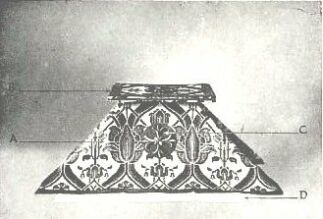
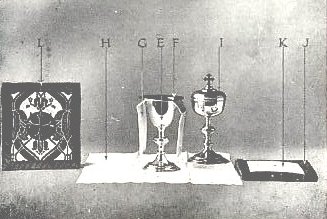
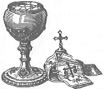
A. Chalice Veil which covers the Chalice underneath B: Burse
C: Cross on front of veil. D: Corporal on which the veiled Chalice sits.
E: Chalice F: Paten
G: Purificator H: Corporal
I: Ciborium J: Folded Chalice Veil
K: Pall L: Burse


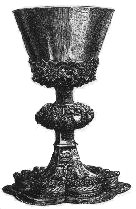
Chalice
The consecrated gold or gilded silver cup used to hold the Precious Blood. Only priests or deacons are allowed to touch the Chalice (though sacristans may in the course of their duties). Pewter Chalices are "okay" for use during times of persecution but, even then, the inside of the bowl must be gilded.

When Mass begins, the Chalice is covered by the folded purificator and the pall (see below).

Paten
The consecrated gold or gilded silver plate on which the Sacred Host is laid. Only priests or deacons are allowed to touch the Paten (though sacristans may in the course of their duties). A Communion Paten has a handle and is held under the chin of one receiving the Eucharist so that in case the Host is dropped, it won't fall to the floor.

Ciborium
A chalice-shaped vessel with a lid used to hold consecrated Hosts for distribution during the Communion of the faithful. It can be made of any material as long as the inside is gilded. It is kept in the Tabernacle between Masses, covered with a white veil (which can be decorated with precious metals).

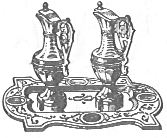
Cruets
These vessels hold the water and wine before Consecration

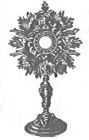
Monstrance (or "Ostensorium" or "Ostensory")
A gold or silver vessel, often in a sunburst shape, with a clear glass area, called a "luna," for viewing the Sacrament. The Host is kept in place inside the crystal or glass frame by a crescent shaped gold or silver gilded clip called a "lunette." The monstrance is used during Benedictions and processions, etc., for adoration by the faithful. It doesn't require a blessing, but it should be blessed.

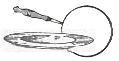
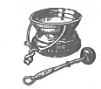
Aspersory and Aspergillum (or "Aspergill")
The Aspersory is a container for holding Holy Water. The Aspergillum is a stick-shaped implement with holes in it to dip into the Aspersory and catch the Holy Water for sprinkling the people and things. Because of Leviticus 14:49-52, Numbers 19:18, Psalm 50:9, etc., the aspergillum used to contain crushed Biblical hyssop (Origanum syriacum) to catch the water, but nowadays a small sponge is more often used.

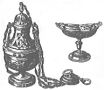
Thurible (or "Censer") and Boat
A thurible is the incense burner used at Mass. It hangs from chains so it can be swung to incense people and things. The boat is where the incense is stored until it is placed in the
thurible.

Pyx
A small container, also called a custodia, used to carry the Sacred Host when taking it to the sick and homebound. It is made of the same material as the Ciborium -- gilt on the inside.


Altar Linens


Chalice veil
Small silk cloth, of the same color as the priest's vestments, used to cover the Chalice


Purificator (or "Mundatory" or "Purificatory")
Rectangular piece of linen or hemp used to wipe the Chalice before the Offertory and after Communion, the priest's lips and fingers. It requres no special blessing.


Pall
A blessed, stiff square piece of linen, sometimes decorated with a Cross or other embroidery, used to cover the Chalice to prevent impurities from falling into it. If it is embroidered or made of silk, the side touching the Chalice must still be made of linen.

Another type of pall is the cloth used to cover coffins at Requiem Masses.


Finger Towels
These may be made of any material (preferably linen) and are used at the lavabo and after Communion


Corporal
A blessed square linen cloth which is spread out by the priest in the middle of the Altar. From the Catholic Encylopedia, "after it [the corporal] is washed, bleached, and ironed, it is folded into three equal parts, both in its length and in its width, i.e. the anterior part is folded over the middle; then the posterior part is turned down over the anterior part; after this the part at the priest's right is folded over the middle, and finally the part at the priest's left is folded over these. The corporal is placed in the burse in such a manner that the edge of the last fold is towards the opening of the burse."


Burse
A 10-inch square container to hold the Corporal. The burse covers the chalice before the Mass, with the opening of the burse facing toward the priest. (The leather pouch used to hold the pyx is also called a burse)


@@@@@@@@@@@@@@@@@@@@@@@@@@@@@

Thimble Full of Sarcasm
One of These Things Just Doesn't Belong

OK, we all remember our mothers saying "If you can't say anything nice then don't say anything at all", right? Right...BUT (Pee Wee Herman quote:"Everyone has a big but...!")...a pinch of cayenne spices up a spaghetti sauce so here is my sarcastic spice of the week....thimble size.

One of these things is not like the others,
One of these things just doesn't belong,
Can you tell which thing is not like the others
By the time I finish my song?


@@@@@@@@@@@@@@@@@@@@@@@@@@@@@

Summorum Pontificum One Year Later

An Interview with Fr. John Berg, Superior General of the Priestly Fraternity of St. Peter
http://www.remnantnewspaper.com/Archives/archive-2008-summorum_pontificum_one_year_lat.htm
Brian Mershon
THE REMNANT COLUMNIST, Texas


In conjunction with Michael Matt’s exclusive report from the priestly ordinations performed May 30 by Darío Cardinal Cas trillón Hoyos for the Priestly Fraternity of St. Peter (FSSP) in the Cathedral of Lincoln, Neb., The Remnant provides this exclusive interview with Fr. John Berg, Superior General of the FSSP.


Fr. Berg outlines the current growth in apostolates for the F SSP both in the U.S. and worldwide, along with his impressions of the deeper significance behind the recent ordinations by high-ranking members of the Roman curia.

He also provides an update on the FSSP’s role in assisting with the education of diocesan and religious priests wishing to learn the Traditional Roman rite. In addition, Fr. Berg touches on some controversial issues regarding concelebration and the “cross-pollination” of the two forms of the Roman rite.

Continued at original article...(click here)


@@@@@@@@@@@@@@@@@@@@@@@@@@@@@

Guest Blogger, Michael J. O’Neill
The Transformation of the Jewish Liturgy into the Eucharistic Sacrifice of the New Law
With extracts from How Christ Said the First Mass by Fr. James L. Meagher, 1984 TAN reprint and the Catechism of the Council of Trent.

Our Lord Jesus Christ, the High-priest of the New covenant, instituted the Eucharistic Sacrifice of the New Law at the Last Supper; this is an indisputable doctrine of the holy Catholic Church. Moreover, our Lord Jesus transformed the ancient Jewish Temple liturgy, and the Passover, familiar to His twelve apostles and their successors, into the Eucharistic Sacrifice of the New Law. This author uses the proper noun Eucharistic Sacrifice of the New Law as opposed to Roman-rite of the Mass because the Eastern Catholic Churches employ different terms for the one, same perpetual Eucharistic Sacrifice; for example, Byzantine Liturgy, Divine Liturgy, or Eucharistic Liturgy.

Our Lord, the Apostles, and His disciples frequently participated in the Temple liturgy, particularly on the Sabbath, which occurred on Saturday. Inside the magnificent Temple was the Holy of Holies, a room measuring 30 square feet, “concealed by a great veil, measuring 60 by 30 feet, so heavy and thick that it required 300 Hebrew priests to hang it” (Fr. Meagher, pg. 19). Access to the Holy of Holies was restricted because it signified the closure of Heaven because of Adam’s sin; only the high priest could enter this room on the Day of Atonement to sprinkle the blood of sacrificial animals killed in the Priests’ Court. This liturgy prefigured our Lord’s bloody on the cross and His reopening of Heaven to mankind. Once inside the Holy of Holies the high priest venerated the Ark of the Covenant, constructed of fragranced acacia wood, measuring 3 feet long and 2 feet wide and 2 feet high, covered with gold; prototypes of tabernacles placed in every Catholic sanctuary. Stored inside the Ark was a “gold plated cup, like a ciborium, was preserved the miraculous manna that fell from Heaven to feed the wandering Hebrews in the desert; the manna profoundly signified the Eucharist which Christ now feeds us during the Holy Eucharistic Sacrifice” (Fr. Meagher, pg. 20). The presence of the Blessed Sacrament inside the tabernacle fulfills what our Lord said to Moses, “and they shall make me a sanctuary and I will dwell in the midst of them” (Book of Exodus 35: 8, Douay-Rheims).

In the middle of the Holy of Holies is a golden alter, a prototype of Jesus Christ, which was incensed by the Jewish priest just like Catholic priests incense the alter before or during the Eucharistic Sacrifice. Remarkably, Eastern Catholic Churches’ arrange their sanctuaries like the gold alter of incense inside the Holy of Holies. Also placed in the Holies is a large candleholder, called candelabrum, with 7 lamps signifying both the 7 gifts of the Holy Ghost and the seven sacraments.

This concludes the first installment of how our Lord transformed the Hebrew Liturgy into the Eucharistic Sacrifice of the New Law.

@@@@@@@@@@@@@@@@@@@@@@@@@@@@@

A Parable
The Story of Two Monks

Two monks were making a pilgrimage to venerate the relics of a great Saint. During the course of their journey, they came to a river where they met a beautiful young woman -- an apparently worldly creature, dressed in expensive finery and with her hair done up in the latest fashion. She was afraid of the current and afraid of ruining her lovely clothing, so asked the brothers if they might carry her across the river.

The younger and more exacting of the brothers was offended at the very idea and turned away with an attitude of disgust. The older brother didn't hesitate, and quickly picked the woman up on his shoulders, carried her across the river, and set her down on the other side. She thanked him and went on her way, and the brother waded back through the waters.

The monks resumed their walk, the older one in perfect equanimity and enjoying the beautiful countryside, while the younger one grew more and more brooding and distracted, so much so that he could keep his silence no longer and suddenly burst out, "Brother, we are taught to avoid contact with women, and there you were, not just touching a woman, but carrying her on your shoulders!"

The older monk looked at the younger with a loving, pitiful smile and said, "Brother, I set her down on the other side of the river; are you still carrying her?"